
A room that’s hard to be in is hard to do therapy in. Fluorescent lights, a loud waiting area, a group that moves fast, a question phrased as a metaphor: for a lot of people these are background noise. For people with sensory processing differences, whether that comes with autism, ADHD, a trauma history or nothing else attached, they can take up most of the available bandwidth before the session even starts.
That’s why we’re proud to welcome The Sensory Safe Solution to Arya Therapy Center in Newton on Tuesday, October 27, for a two-hour training on autism and sensory sensitivities in treatment settings. Here’s what we’re training on, and what it changes for anyone who comes to us for care.
Reading the room correctly
The core of the training is learning to recognize a sensory response for what it is, instead of reading it as something about the person’s attitude or engagement. The Sensory Safe Solution calls these the look-alikes, and every clinician has seen them:
- Someone goes quiet mid-session, stops responding, seems frozen. That may be a shutdown: overload turned inward, not disengagement. What helps is reducing demands, not requiring eye contact or a quick answer, and offering somewhere quieter.
- Someone rocks, taps, fidgets, repeats a sound. That may be stimming: self-regulation, not a symptom to suppress. What helps is leaving it alone, and if it’s ever unsafe, offering a fidget or a movement break instead of “stop.”
- Someone needs the same seat, the same order, the same schedule. That may be a need for predictability; routine frees up capacity for the hard work. What helps is advance notice when something changes, and explaining why.
- Someone avoids the waiting room or scans a noisy space. That may be sensory avoidance: a logical response to real discomfort. What helps is asking what about the space is hard and offering a quieter room or an off-peak time.
- Someone takes a metaphor literally or questions the wording of an exercise. That may be literal communication: they want clarity, not conflict. What helps is direct language, concrete examples, and welcoming the questions.
- Someone doesn’t make much eye contact and stays quiet in group. That may be a different way of expressing connection, not a lack of it. What helps is not using eye contact or airtime to measure engagement, and offering paired activities or written check-ins.
- Someone has a sudden, intense reaction that seems out of proportion. That may be a meltdown: an involuntary response to overload, not a choice. What helps is reducing input, giving space, waiting, and processing it afterward once the person is regulated.
None of this replaces clinical judgment, and none of it is a diagnosis. It’s a question to ask before a label goes in the chart: could this be sensory or communication?
Why it matters most in a group program
Our partial hospitalization and intensive outpatient programs are group-heavy by design, and groups are where sensory and social effort cost the most. One of the signs the training flags is being exhausted after groups, even ones the person enjoyed. That isn’t a sign the group isn’t working. It’s a sign the person is spending a lot of energy on things other people don’t have to think about: the noise, the pacing, the unspoken rules of when to talk, holding still, holding eye contact.
Many adults with sensory differences have spent years compensating for that, often very well, which is exactly why it goes unnoticed. The training’s point is simple: if we can lower the cost of being in the room, more of a person’s energy goes to the work they came for.
What This Looks Like in Practice at Arya
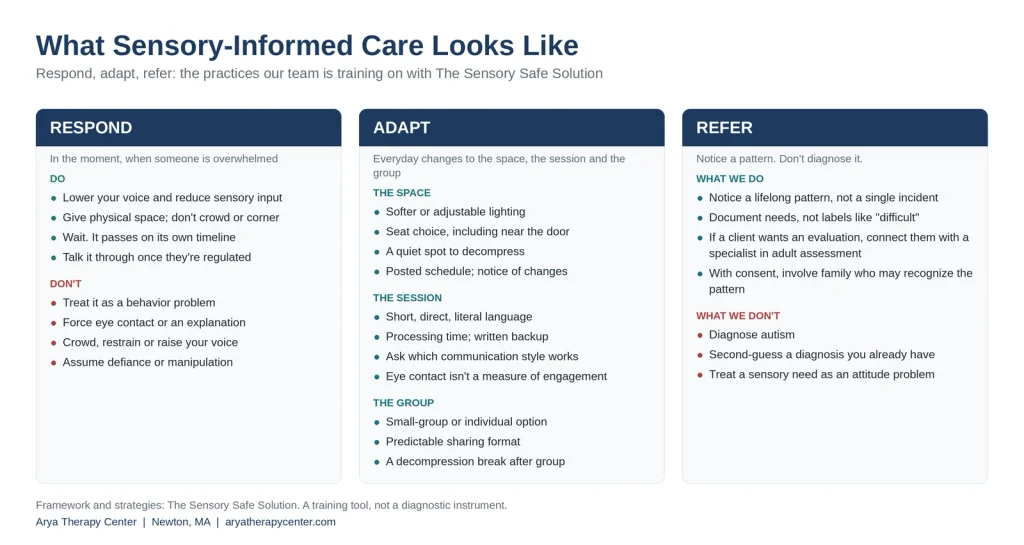
Most of what the training asks for costs nothing. Here’s what our clinicians and front-desk team are putting into practice.
The space. Softer or adjustable lighting where we can. Seat choice, including near the door and away from traffic. A quieter spot to decompress between groups. A posted schedule in our programs, with notice when something changes.
The session. Short, direct, literal language when that’s what works for you. Processing time without rushing or repeating. Written backup for instructions and between-session work. Asking which communication style works best instead of assuming. And eye contact is not treated as proof of listening or honesty.
The group. A small-group or individual option when a full room is too much. Predictable sharing formats, like going around the circle or written prompts, so no one is caught off guard. A decompression break after group. With the client’s consent, a brief word to peers about why someone stims or doesn’t make eye contact.
In the moment. If someone is overwhelmed: lower the voice, reduce the input, give physical space, and wait. It passes on its own timeline. Talk about it afterward, once the person is regulated. What we don’t do is treat it as a behavior problem, force eye contact or an explanation, crowd or raise our voice, or assume defiance.
What we don’t do: diagnose
This training does not make anyone on our team an autism specialist, and it doesn’t ask us to diagnose. It asks us to notice. If a client has a diagnosis of anxiety, depression, OCD, ADHD or anything else, nothing here second-guesses it. Autism and mental health conditions can and do co-occur, and sensory differences show up across all of them.
What the training does give us is a clear path when a client raises the question themselves. If you’ve wondered about autism and want an evaluation, we’ll connect you with a psychologist or specialist experienced in adult assessment, and we’ll document what we’ve noticed about sensory triggers and communication needs in a way that’s useful to them, rather than labels like “difficult” or “resistant.”
Who’s teaching it
The Sensory Safe Solution grew out of a salon. Founder Kate Owens-Heins, a stylist and salon owner of more than 20 years, is the mother of a son with autism. After years of watching how a routine haircut could turn into a crisis for autistic kids, she spent five years building a method that worked and launched The Sensory Safe Solution in 2023 to teach it. Thousands of professionals across the U.S. and abroad have since gone through the training, and the curriculum has expanded into healthcare and behavioral health.
Rocco Danieli, a master barber in Massachusetts and founder of Uplift Provisions Co., is bringing the program to treatment settings in Massachusetts.
How to ask for what you need
You don’t need a diagnosis, or a reason, to ask for accommodations here. A few things that help:
- Mention sensory needs when you book or in your first session. Light, sound, scent, seating, how much notice you want before a change.
- Ask for directness. If you want your therapist to be more literal, more explicit, or to check in more often, say so. We’ll honor it.
- Use the format that works. We offer morning, evening and telehealth appointments; for some people, a session from home is the accommodation.
- Tell us if the space isn’t working. We would rather adjust the room than lose you.
Frequently asked questions
Does Arya Therapy Center diagnose autism?
No. If you want an evaluation, we’ll help connect you with a specialist experienced in adult autism assessment, and we’ll share what we’ve observed if that’s useful to you.
Does this mean Arya specializes in autism?
No. We provide PHP, IOP and outpatient therapy for anxiety, depression, trauma, OCD, ADHD and related conditions. This training helps our team support clients with sensory differences within that care.
I don’t have a diagnosis. Can I still ask for sensory accommodations?
Yes. If something about the environment or the way we communicate would make therapy easier for you, tell us. That’s enough.
Is this a certification or credential?
It’s a professional development training for our staff. It doesn’t change anyone’s license or qualifications, and we won’t describe it as if it did.
Reach out
To ask about our services or talk through what you need before a first appointment, call (857) 240-1624 or contact us online. You can also verify your insurance first.